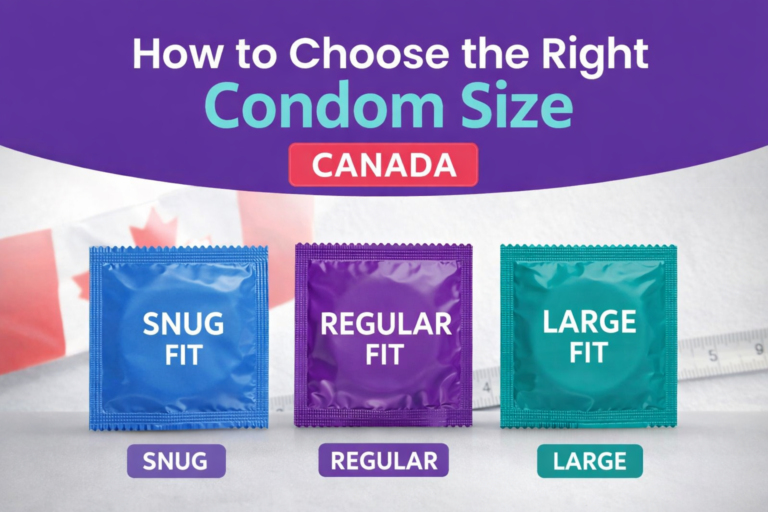
Finding the right condom size can make a major difference in comfort, confidence and reliability. A condom should feel secure without being painfully tight, and it should stay in place without slipping or bunching.
The challenge is that condom sizing is not standardized across brands. A condom labelled “regular” by one manufacturer may be wider or narrower than a regular condom from another. That is why it is helpful to compare the actual measurements rather than relying only on labels like snug, standard, large or XL.
This Canadian condom size guide compares popular options from Trojan, Durex, LifeStyles, SKYN and Okamoto using nominal width, length, centimetres and inches.
Nominal width is the measurement across a condom when it is laid flat. It is not the same as penis diameter or circumference.
| General Fit | Typical Nominal Width | Width in Inches | Best Starting Point |
|---|---|---|---|
| Snug or close fit | 49–52.5 mm | 1.93–2.07 in | Standard condoms feel loose, bunch or slip |
| Regular or standard | 53–54 mm | 2.09–2.13 in | Standard condoms usually feel secure and comfortable |
| Large | 55–57 mm | 2.17–2.24 in | Standard condoms feel restrictive or difficult to roll down |
| Extra large | 58–60+ mm | 2.28–2.36+ in | Large condoms still feel tight or do not provide enough room |
These ranges are a useful starting point rather than a universal sizing system. Condom shape, material and stretch can also change how two condoms with similar measurements feel.
The chart below compares representative products commonly available in Canada. Measurements are approximate, and manufacturers may update product specifications. Always check the packaging or individual product description before purchasing.
| Brand and Condom | General Fit | Nominal or Base Width | Width in Inches | Length | Length in Inches |
|---|---|---|---|---|---|
| LifeStyles Snugger Fit | Snug | 49 mm | 1.93 in | Varies by market | Check package |
| SKYN Snug Fit | Snug | Approximately 49–51 mm | 1.93–2.01 in | Approximately 165 mm / 16.5 cm | 6.5 in |
| Durex Sensi-Thin Close Fit | Close fit | 52.5 mm | 2.07 in | Not consistently published | Check package |
| Durex Tropical | Close fit | 53 mm | 2.09 in | Not consistently published | Check package |
| Trojan Original / ENZ | Regular | 53 mm | 2.09 in | 170–190 mm / 17–19 cm | 6.7–7.5 in |
| Trojan Ultra Thin | Regular | 53 mm | 2.09 in | 170–190 mm / 17–19 cm | 6.7–7.5 in |
| LifeStyles Natural Feeling | Regular | 53 mm | 2.09 in | Varies by product | Check package |
| SKYN Original | Regular | 53 mm | 2.09 in | Approximately 180 mm / 18 cm | Approximately 7.1 in |
| SKYN Elite | Regular | 53 mm | 2.09 in | Approximately 180 mm / 18 cm | Approximately 7.1 in |
| Durex Invisible | Regular or large | 54 mm | 2.13 in | Not consistently published | Check package |
| Trojan Magnum Original | Large, tapered | 55 mm at base | 2.17 in | 180–200 mm / 18–20 cm | 7.1–7.9 in |
| Durex Sensi-Thin | Large | 56 mm | 2.20 in | Not consistently published | Check package |
| Durex Real Feel | Large | 56 mm | 2.20 in | Not consistently published | Check package |
| SKYN Large | Large | 56 mm | 2.20 in | Approximately 180 mm / 18 cm | Approximately 7.1 in |
| Trojan Magnum Raw | Large, tapered | 57 mm at base | 2.24 in | 190–210 mm / 19–21 cm | 7.5–8.3 in |
| Trojan Magnum XL | Extra large, tapered | 58 mm at base | 2.28 in | 180–200 mm / 18–20 cm | 7.1–7.9 in |
| Durex Sensi-Thin XL | Extra large | 60 mm | 2.36 in | Not consistently published | Check package |
Important: Some shaped condoms are wider through the middle or near the head than they are at the base. For example, Trojan Magnum condoms generally have a tapered or flared shape. The base measurement is therefore not always the widest part of the condom.
Nominal width is the width of an unrolled condom when it is laid flat. It is generally measured near the base and expressed in millimetres.
Nominal width is not the same as the circumference of an erect penis. Condoms stretch considerably, so you should not simply divide your girth in half and look for an identical condom width.
The measurement is most useful when comparing one condom with another. If a 53 mm condom feels loose, trying a 49–52 mm option may give you a more secure fit. If a 53 mm condom feels uncomfortably tight, a 55–57 mm option may be more comfortable.
Measure while fully erect.
Place a ruler or measuring tape along the top of the penis. Measure from the base, where the penis meets the body, to the tip.
Most condoms are long enough for most users. Width and girth are often more important when choosing between snug, regular and large condoms.
Wrap a flexible measuring tape around the thickest part of the shaft. Keep the tape comfortably against the skin without pulling it tightly.
If you do not have a flexible tape, use a piece of string and then measure the string against a ruler.
Measure more than once to confirm the result.
There is no perfect conversion between penis girth and nominal condom width because materials, shapes and personal preferences vary. The following guide can provide a practical starting point.
| Erect Girth | Suggested Starting Fit |
|---|---|
| Under approximately 4.5 in / 11.4 cm | Snug or close fit |
| Approximately 4.5–5 in / 11.4–12.7 cm | Regular fit |
| Approximately 5–5.25 in / 12.7–13.3 cm | Regular or large, depending on comfort |
| Approximately 5.25–5.75 in / 13.3–14.6 cm | Large fit |
| Over approximately 5.75 in / 14.6 cm | Large or extra-large fit |
Treat these as starting points rather than strict rules. Two people with the same measurements may prefer different condom widths or shapes.
A condom may be too small if:
If a standard condom feels restrictive, explore our selection of large condoms.
A condom may be too large if:
If regular condoms feel loose, browse our snug fit condoms for narrower options.
Many standard Trojan condoms are approximately 53 mm wide and between 170 and 190 mm long. Magnum products offer more room, but the exact size differs by style.
Trojan Magnum Original has a base width of approximately 55 mm, while Magnum XL is approximately 58 mm at the base. Magnum condoms are also flared, meaning the middle portion may be wider than the base.
Durex Canada offers a wide range of nominal widths. Sensi-Thin Close Fit is approximately 52.5 mm, while many regular or large Durex options range from 54 to 56 mm. Sensi-Thin XL is approximately 60 mm wide.
Because Durex uses labels such as Close Fit, Large and XL differently from some other brands, compare the millimetre measurement rather than relying on the label alone.
SKYN offers non-latex polyisoprene condoms in multiple widths. SKYN Original and SKYN Elite are approximately 53 mm wide, while SKYN Large is approximately 56 mm. SKYN Snug Fit provides a narrower alternative for users who experience slipping with standard condoms.
Browse our SKYN non-latex condoms to compare available options.
Many standard LifeStyles condoms have a nominal width of approximately 53 mm. LifeStyles Snugger Fit is narrower and is designed for people who find regular condoms too loose.
Because LifeStyles also manufactures several contoured and flared products, shape can affect the fit even when the stated nominal width is similar.
Both measurements matter, but width is usually the more important factor when deciding between snug, regular and large condoms.
Most condoms are long enough to cover the majority of erect penis lengths. A condom does not need to be completely unrolled if the shaft is fully covered and the condom remains secure.
Width affects how tightly the condom grips the shaft. A condom that is too narrow may feel restrictive, while one that is too wide may slip.
Yes. Latex, polyisoprene and polyurethane do not stretch or feel exactly the same.
Latex condoms are highly elastic and are available in the widest selection of sizes and styles. Polyisoprene condoms, including SKYN and some Durex non-latex products, are soft and stretchy but may feel different from a latex condom with the same nominal width.
Polyurethane condoms typically have less stretch than latex or polyisoprene. The exact measurements and manufacturer fit recommendations are therefore especially important.
People with latex allergies or sensitivities can browse our selection of non-latex condoms.
A properly fitting condom should:
Trying two nearby sizes is often the easiest way to find your preferred fit. For example, someone currently using a 53 mm condom might compare it with a 49–52 mm snug option or a 55–56 mm large option.
Different brands can also feel different at the same nominal width because of their shape, lubricant, thickness and material.
Once you have identified your likely size range, compare the available materials, shapes and sensations.
Condoms Canada offers discreet online ordering and delivery across Canada, making it easier to compare sizes and try different fits without relying on the limited selection available in many local stores.
Many regular condoms have a nominal width of approximately 53 or 54 mm. However, there is no single Canadian standard shared by every manufacturer.
A 53 mm condom is generally considered a regular or standard fit. Examples include many Trojan, LifeStyles and SKYN products.
A 56 mm condom is generally considered large or roomier than standard. Examples include SKYN Large and several Durex products.
A 49 mm condom is usually considered snug or close fitting. It may be suitable when standard condoms slip, bunch or feel insecure.
It may be too small if it is painfully tight, difficult to roll down, leaves strong pressure marks or feels likely to tear.
It may be too large if it slips, bunches around the base, feels unstable or starts to come off during sex.
No. Magnum Original, Magnum Raw, Magnum XL and other Magnum styles have different base widths, lengths and shapes. Magnum XL is wider at the base than Magnum Original, while several Magnum products also have a flared shape.
Yes. SKYN offers snug, regular and large options. SKYN Original and Elite are generally around 53 mm wide, while SKYN Large is approximately 56 mm.
Measure both, but girth and nominal width are usually more helpful when choosing between snug, regular and large condoms.
A condom does not necessarily need to be completely unrolled. It should cover the shaft securely, remain in place and not feel painfully tight. Try a longer or larger option if it does not provide adequate coverage.
Measurements are approximate and may change. Always confirm the dimensions shown on the product packaging before use.

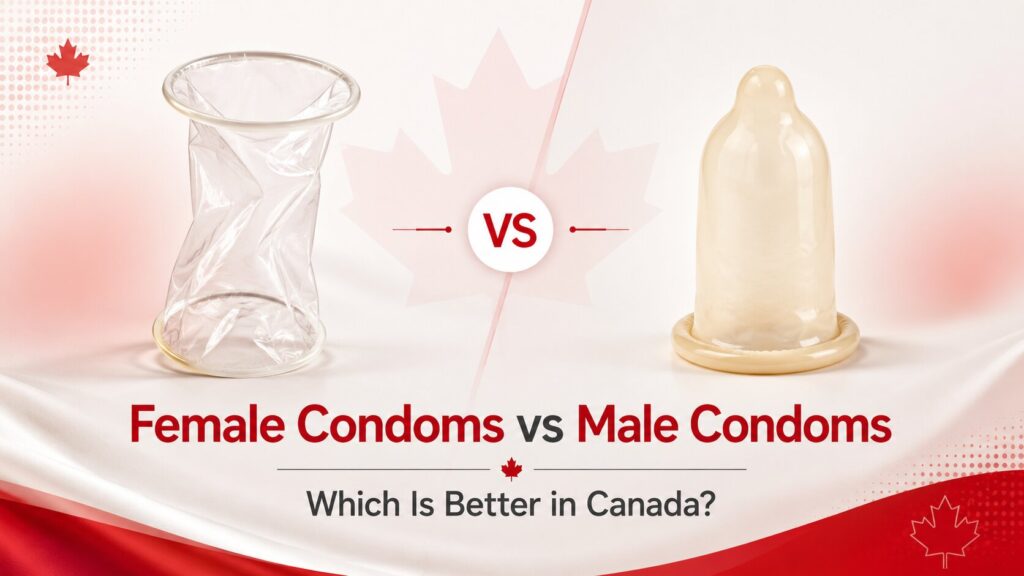
Choosing between female condoms and male condoms is not just a matter of preference. The two options differ in who controls insertion, how they feel, what they are made of, how effective they are, and...






Keeping Your Distance With Doggy Style Sex It’s all theory, of course, and you can base it on Pythagorean measurements, but you may—or may not—be safer by keeping your distance with doggy style sex in...

Sex Doesn’t Stop In these difficult times with health management crises upon us, we need to be cognizant of virus avoidance strategies until better methods of management are available. If you are stuck at home...

COVID-19 Statement – Shipping and Handling Updated – January 14, 2022 PBW Resources – CondomsCanada.com These are times when the “new normal” almost defies description. We are therefore advising our customers and prospective customers about...

Happy Hour Condoms-Lubricants-Sensual Massage Happy Hour is the time of day when you just want to let go of the stresses of the workplace. We decided to take a cue from our favorite watering holes...