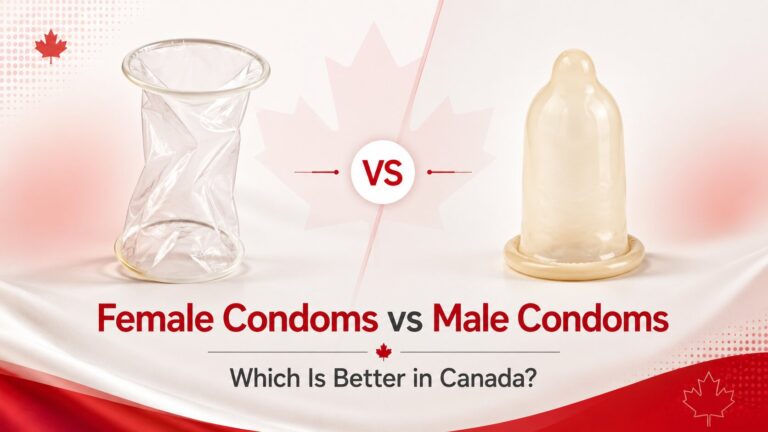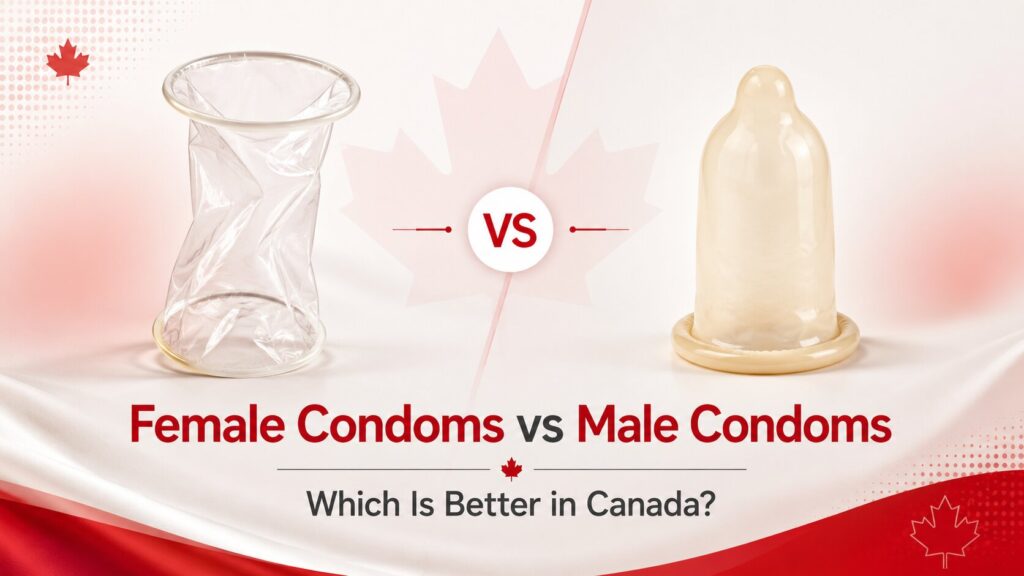
Choosing between female condoms and male condoms is not just a matter of preference. The two options differ in who controls insertion, how they feel, what they are made of, how effective they are, and what they cost. If you have only ever used male condoms, you might be surprised by what female condoms offer, and by where they fall short.
This guide compares female condoms and male condoms side by side, with a focus on what matters to people buying and using them in Canada. We cover effectiveness, sensation, materials, pricing in CAD, and where to buy both types with discreet shipping across the country.
TL;DR: Female condoms and male condoms both protect against pregnancy and STIs, but female condoms give the receptive partner control over insertion, are latex-free, and can be put in place hours before sex. Male condoms are cheaper, more widely available, and slightly more effective with typical use. For most people, the best choice depends on who you want in charge of protection and whether latex allergies or sensation matter to you.
A female condom, also called an internal condom, is a barrier method worn inside the body rather than on the penis. The most common version sold in Canada is the FC2 Female Condom, made of nitrile, a soft synthetic material that contains no latex proteins. It has a flexible inner ring that holds it in place against the cervix and an outer ring that stays outside the body to cover the vulva.
The term “internal condom” is increasingly used by health organizations like Planned Parenthood and the NHS because it is more accurate. The condom is inserted by the receptive partner, which means the person being penetrated controls when and how it goes in. This is one of the key differences from male condoms, and it matters more than most people realize.
You can learn more about female condoms in Canada on our dedicated landing page, or shop the FC2 Female Condom directly.
A male condom, sometimes called an external condom, is a thin sheath that rolls onto an erect penis before sex. It is the most widely used barrier method in the world. Most male condoms are made of latex, but non-latex versions made from polyurethane or polyisoprene are available for people with latex allergies.
Male condoms are worn by the penetrating partner, who is responsible for putting it on correctly and removing it after sex. They come in a wide range of sizes, textures, thicknesses, and flavours. If you want to explore the full range, browse our best condoms in Canada guide for detailed recommendations by category.
Effectiveness is usually the first question people ask, and the numbers are close but not identical. Here is how female condoms and male condoms compare for preventing pregnancy:
| Method | Perfect Use | Typical Use |
|---|---|---|
| Female condom (internal) | 95% effective | 79% effective |
| Male condom (external) | 98% effective | 87% effective |
“Perfect use” means using the condom correctly every single time, with no user error. “Typical use” reflects real-world conditions, where condoms are sometimes put on late, removed too early, or used inconsistently. The gap between perfect and typical use is larger for female condoms, which suggests that the learning curve for inserting them correctly is a bigger factor than the product itself.
Both types of condoms protect against sexually transmitted infections (STIs) including HIV, chlamydia, gonorrhea, and syphilis. The barrier works the same way in both cases: it prevents direct contact between bodily fluids and mucous membranes. Neither type is more or less effective at STI prevention when used correctly.
This is where the comparison gets interesting, and it is one of the most searched questions online. People want to know whether female condoms feel different from male condoms, and whether that difference is good or bad.
The short answer is that female condoms feel different, and for many people, better. Here is why:
Because the female condom is held in place inside the body, it does not grip or constrict the penis the way a male condom does. Multiple studies and user reports note that some men find this more comfortable, with less restriction and no loss of erection. This is one of the most commonly reported advantages in research published by the National Institutes of Health.
Female condoms do not dull sensation the way some male condoms can, particularly thicker latex ones. The nitrile material transfers body heat well, and because the condom is not stretched tightly over the penis, many users report a more natural feeling during intercourse. The outer ring can also provide clitoral stimulation, which male condoms do not.
The most common complaint about female condoms is noise. The nitrile material can produce a rustling sound during sex, especially if there is not enough lubricant. Adding extra water-based or silicone-based lube inside and outside the condom usually solves this. It is worth noting that the FC2 comes pre-lubed, but additional lubricant is often helpful.
Male condoms come in ultra-thin, ribbed, dotted, warming, and flavoured varieties. If sensation variety is your priority, male condoms offer more options. Female condoms are currently available in fewer variations, with the FC2 being the dominant product in Canada.
This is a clear win for female condoms. The FC2 is made of nitrile, which contains no latex proteins. If you or your partner have a latex allergy or sensitivity, female condoms are a safe choice without any need to seek out a specialty product.
For male condoms, latex is the default material. Non-latex male condoms do exist, made from polyurethane or polyisoprene, but they are less common and often more expensive. If latex allergies are a concern, female condoms offer a straightforward solution, while male condoms require you to specifically seek out a non-latex option.
This is the biggest structural difference between the two, and it matters for reasons that go beyond convenience.
With a male condom, the penetrating partner must have an erection before the condom goes on. This means protection is tied to the moment, and any interruption to put on the condom can feel like a pause in the action.
With a female condom, the receptive partner can insert it hours before sex. No erection is needed, and there is no interruption when things get started. This gives the receptive partner control over their own protection, which is particularly valuable in situations where negotiating condom use with a partner is difficult.
The female condom also stays in place after sex, even if the penis is withdrawn or the erection is lost. Male condoms can slip off when the erection goes down, which is a common user error that reduces effectiveness.
Female condoms cost more per unit than male condoms. This is one of the main reasons they are less widely used. Here is a rough comparison of what you can expect to pay in Canada:
| Type | Approximate Cost Per Unit (CAD) | Notes |
|---|---|---|
| Female condom (FC2) | $3 to $5 each | Sold in smaller packs, nitrile material |
| Male condom (latex) | $0.50 to $2 each | Wide range depending on brand and quantity |
| Male condom (non-latex) | $1.50 to $3 each | Polyurethane or polyisoprene options |
The price gap is real, but it narrows when you compare female condoms to non-latex male condoms, which are closer in price. If you are buying female condoms, you are paying for latex-free material, receptive-partner control, and the ability to insert ahead of time. Whether that is worth the extra cost depends on your priorities.
Male condoms are easy to find in Canada. They are sold in pharmacies, grocery stores, and online retailers. Female condoms are harder to find in physical stores, which is one of the reasons people search for them online.
At Condoms Canada, we stock both:
All orders ship in discreet packaging with no indication of the contents on the outside.
One of the reasons female condoms have a higher typical-use failure rate is that many people have never been taught how to insert one. The process is straightforward but takes a little practice the first time.
Female condoms can be inserted up to two hours before sex, which means you do not need to pause in the moment. This is a significant advantage over male condoms for many couples.
| Feature | Female Condom | Male Condom |
|---|---|---|
| Worn by | Receptive partner (inside the body) | Penetrating partner (on the penis) |
| Material | Nitrile (latex-free) | Latex or non-latex (polyurethane, polyisoprene) |
| Effectiveness (typical use) | 79% | 87% |
| Effectiveness (perfect use) | 95% | 98% |
| Can be inserted ahead of time | Yes, up to 2 hours before | No, requires an erection |
| STI protection | Yes | Yes |
| Cost per unit (CAD) | $3 to $5 | $0.50 to $2 (latex), $1.50 to $3 (non-latex) |
| Variety of styles | Limited (FC2 dominant) | Wide (thin, ribbed, flavoured, sizes) |
| Latex allergy safe | Yes, always | Only if non-latex version |
Many men report that female condoms feel better than male condoms because they are not tight on the penis and do not restrict sensation. Research published by the National Institutes of Health found that men reported better comfort, longer-lasting erections, and increased sexual sensation compared to male condoms. However, experiences vary, and some people find the outer ring or the noise takes getting used to.
There is no universal answer, but female condoms tend to provide a more natural sensation because they do not grip the penis tightly and the nitrile material transfers body heat well. Male condoms offer more variety in thickness and texture, so if you prefer ultra-thin or textured options, male condoms give you more choices. The best way to decide is to try both.
Female condoms are less common for three main reasons: higher cost per unit, limited availability in physical stores, and a learning curve for insertion that most people are never taught. They are also less heavily marketed than male condoms. Despite this, they offer unique advantages in partner control, latex-free material, and pre-insertion timing that male condoms cannot match.
The female condom has an inner ring that sits against the cervix and holds the condom inside the body, and an outer ring that rests outside the vulva and keeps the condom from being pushed in during sex. As long as the penis is guided into the condom rather than alongside it, the condom stays in position throughout intercourse.
Female condoms and male condoms are both effective barrier methods that protect against pregnancy and STIs. The right choice depends on what matters most to you. If you want the receptive partner to control protection, need a latex-free option, or value the ability to insert ahead of time, female condoms are the better choice. If you want lower cost, wider variety, and slightly higher typical-use effectiveness, male condoms are the practical default.
Whichever you choose, the most important thing is using one correctly every time. Browse our female condoms page or our best condoms in Canada guide to find the right option, with discreet shipping nationwide.

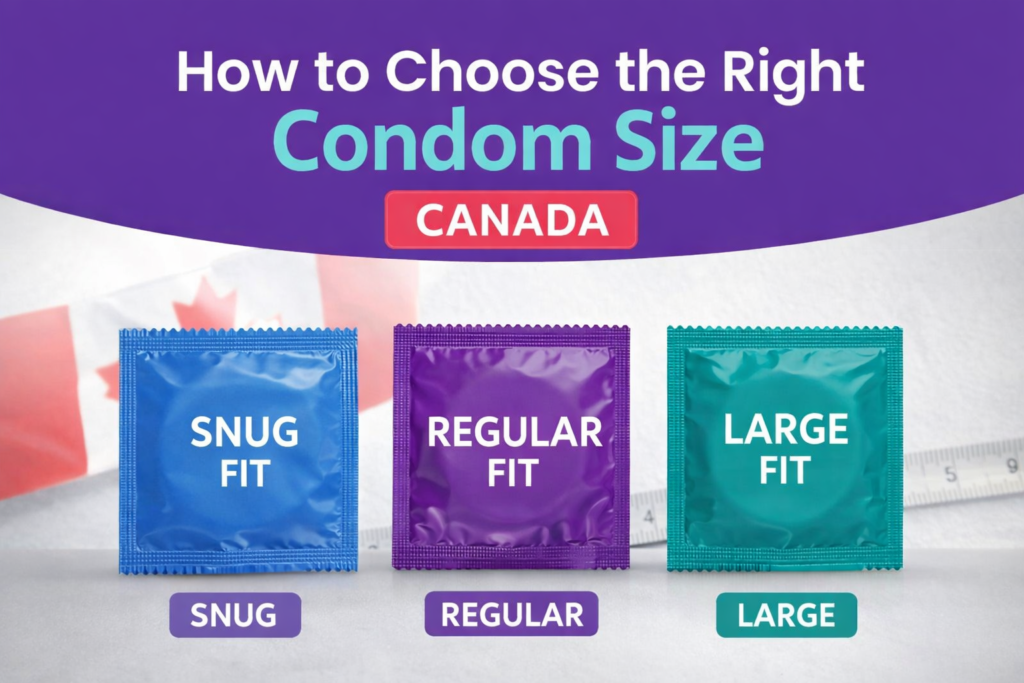
Finding the right condom size can make a major difference in comfort, confidence and reliability. A condom should feel secure without being painfully tight, and it should stay in place without slipping or bunching. The...







Keeping Your Distance With Doggy Style Sex It’s all theory, of course, and you can base it on Pythagorean measurements, but you may—or may not—be safer by keeping your distance with doggy style sex in...

Sex Doesn’t Stop In these difficult times with health management crises upon us, we need to be cognizant of virus avoidance strategies until better methods of management are available. If you are stuck at home...

COVID-19 Statement – Shipping and Handling Updated – January 14, 2022 PBW Resources – CondomsCanada.com These are times when the “new normal” almost defies description. We are therefore advising our customers and prospective customers about...

Happy Hour Condoms-Lubricants-Sensual Massage Happy Hour is the time of day when you just want to let go of the stresses of the workplace. We decided to take a cue from our favorite watering holes...